Align: The Human Design App
- 3.3
- Rating
- 100.00K
- Installs
- Free
- Price

 Analysis by App-foxy
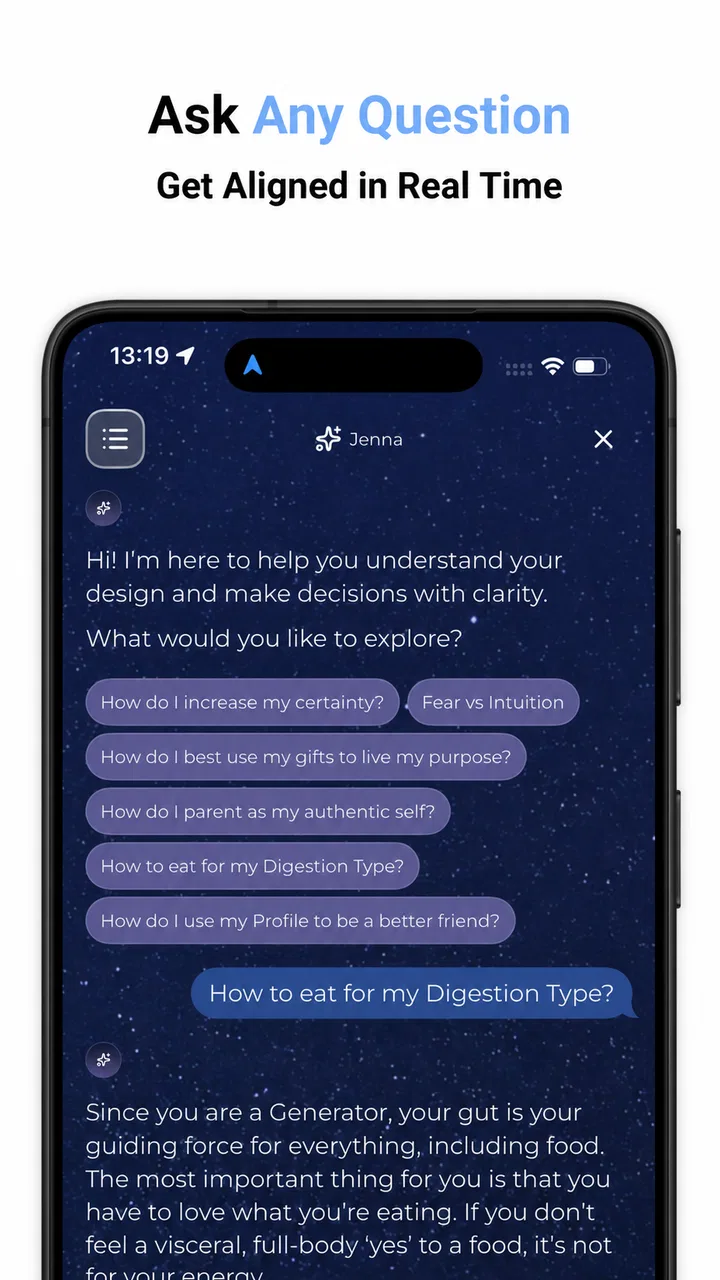
I approached Align: The Human Design App as a reflective education tool rather than a conventional course app. Its subject is Human Design, presented as a way to explore personality, decision-making, and personal patterns. That distinction matters: this is not the kind of education app I would open to memorize vocabulary, prepare for an exam, or follow a fixed lesson plan. I see it as a guided starting point for people who want to examine themselves through a particular framework.
The app is developed by JennaZoe and sits in the Education category. It is free to install, carries a Teen content rating, and runs on devices using Android 9 or later. The current version is 4.0.8, and the app has passed the 100K-install mark. Its average score is 3.3 from around 740 ratings, which gives me a useful first impression: enough people have tried it to make the app established, but the rating also suggests that the experience will not suit everyone equally.
How I would decide whether Align is right for me
My first decision criterion would be curiosity. If I already enjoy journaling, personality systems, astrology, meditation, or other forms of self-reflection, the app has a clear reason to exist on my phone. It gives that curiosity a dedicated place instead of leaving me to collect disconnected articles and short social-media explanations.
You May Also Like

 Blood Strike: 2.5 Anniversary
Blood Strike’s Loadouts Turn Every Drop Into a Tactical Gamble
A close look at Blood Strike’s custom loadouts: how fast access to signature weapons reshapes its battle royale rhythm, rewards preparation, and narrows the gap between fights.

 Pandora - Music & Podcasts
Pandora’s Music Is Easy to Start, but Harder to Recover
Pandora’s strength is its low-effort path from a seed to a station. Its weak spot is how much confidence it asks you to place in connection, setup, and quiet recovery.

 8 Ball Pool
 Is Built on Rivalries, Rematches, and Routine
A close look at the rivalries, rematches, shared routines, and unanswered safety questions that turn a quick pool match into a persistent mobile community.

 Samsung Music
’s Quiet Strength Is Playing What You Already Own
Its reach comes less from spectacle than from dependable access to a personal library. That simplicity is both the app’s strongest retention engine and its ceiling.

 AccuWeather: Weather Radar
AccuWeather Review: A Quick, Clear Forecast for Everyday Decisions
For everyday plans, the best forecast is the one you can understand quickly. AccuWeather makes rain timing, radar, and local conditions easy to act on, with a few trade-offs.

 Hill Climb Racing
Why Hill Climb Racing Still Turns Crashes Into One More Run
A tiny car, a bumpy hill and one more upgrade: Hill Climb Racing keeps resurfacing because its simple chaos makes every near-miss feel personal.
More From Our News Desk



My second criterion would be how literally I expect to take the material. I would use the app as a reflective lens, not as a scientific assessment or a substitute for professional advice. That does not make the experience useless; it simply sets a healthier boundary. A framework can help me notice habits and ask better questions without becoming the final authority on my relationships, work, health, or identity.
The third question is whether I want an open-ended experience or a tightly structured learning path. Traditional education apps usually make their purpose obvious: a language app gives me exercises, a revision app gives me tests, and a course platform gives me lessons to complete. Align is more personal and interpretive. That can feel welcoming when I want to explore, but less satisfying when I am looking for measurable progress.
I would also consider how patient I am with terminology. Human Design has its own vocabulary, and any newcomer may need time to understand how the concepts relate to one another. I found that the best way to approach the app is slowly: read one idea, compare it with my own experience, and return later. Trying to absorb everything in one sitting makes the process feel more confusing than enlightening.
What the first sessions are best used for
Rather than treating the app like a personality verdict, I would begin with a notebook or a notes page. After reading a section, I would write down one statement that feels familiar, one that feels questionable, and one that I want to observe during the week. This simple method turns passive reading into an experiment in self-awareness.
A realistic everyday use case would be opening Align after a difficult workday. Suppose I have spent hours agreeing to requests and then felt drained by the evening. I could read a relevant part of the app, not to decide that it explains everything, but to identify a question: did I say yes because I genuinely wanted to, or because I wanted to avoid disappointing someone? I could then watch for that pattern during the next few days. That is where the app becomes useful to me: not as an answer machine, but as a prompt for noticing behavior.
Another practical routine would be a short Sunday review. I could choose one concept, write down two moments from the previous week that seem connected to it, and decide whether the idea helps me describe my experience more clearly. If it does not, I can set it aside. This prevents the common mistake of forcing every event to fit a system simply because the system offers an explanation.
Where the app wins over ordinary alternatives
Its strongest advantage is focus. Instead of searching across blogs, videos, and social posts, I can keep my exploration inside an app built around Human Design. That makes it easier to return to the subject when I have a few quiet minutes. The dedicated format also feels less distracting than trying to learn through an endless social feed, where dramatic interpretations often compete for attention.
I also appreciate the low barrier to trying it. The app is free, so I do not have to make a financial commitment before deciding whether the topic interests me. That is especially valuable for beginners who have heard about Human Design but do not yet know whether they want a deeper relationship with it.
The developer, JennaZoe, has positioned the experience around alignment and self-understanding rather than academic instruction. In practice, that makes the app more approachable for someone who wants a gentle entry point. I would recommend it to a friend who feels overwhelmed by long explanations and wants to see whether the subject resonates before investing time elsewhere.
Another quiet strength is that the app can support private reflection. I do not need to discuss every thought with a group or publish an interpretation. For a personal subject, that matters. I can read, pause, and decide what is useful without turning the experience into a performance.
Limits that affect the decision
The average rating of 3.3 tells me to keep expectations measured. I would not install this expecting a universally polished or universally persuasive experience. Some readers may find the material illuminating, while others may feel that it is too abstract, too interpretive, or not sufficiently structured.
The app may also be a poor fit for someone who wants evidence-based psychological assessment. Human Design is presented as a personal framework, and I would not use its interpretations to diagnose myself, label another person, or make a major medical, financial, or relationship decision. If that is the kind of certainty I am seeking, a qualified professional or a more conventional educational resource would be a better choice.
There is also a learning-curve trade-off. A specialized vocabulary can create depth, but it can also slow down the first few sessions. I would not judge the entire app after a quick skim. At the same time, I would not keep forcing myself through material that remains unclear after several attempts. Personal growth should not feel like decoding a private language with no practical benefit.
The free entry point does not mean every part of the experience is necessarily free. In-app purchases range from $0.99 to $69.99 per item. That is a wide span, so I would pay attention to each purchase screen and decide in advance how much, if anything, I am willing to spend. I would begin with the free experience and only consider an optional purchase after I had used the app long enough to identify a specific benefit I wanted.
Where another type of app may fit better
If my main goal were learning a language, studying for a qualification, or building a daily academic habit, I would choose a dedicated learning platform instead. Those apps generally make progress easier to measure. Align is better when the desired outcome is reflection, not a certificate or a score.
If I wanted broad mental-health support, I would look for an app designed specifically around evidence-based exercises, mood tracking, or access to licensed professionals. Align can encourage useful questions, but I would not confuse its Human Design material with therapy. The difference is important when I am dealing with persistent anxiety, depression, trauma, or a serious personal crisis.
If I wanted a quick introduction, a short article or video might be more efficient. The advantage of Align appears when I want to return to the subject repeatedly and build a personal routine around it. A one-off explanation may be enough for casual curiosity, while the app makes more sense for someone who expects to revisit the ideas.
There is a similar trade-off with journaling apps. A plain journal gives me complete freedom and does not ask me to interpret my experiences through a predefined system. Align gives me prompts and concepts that may help when I do not know what to write about. I would choose the plain journal if I felt the framework was influencing my self-image too strongly; I would choose Align when I wanted structure to start a reflection.
Social communities can offer conversation and multiple viewpoints, but they also bring noise and pressure. Align is the better starting point if I prefer exploring privately. A community may be more useful later if I want to compare interpretations, ask questions, or hear how other people apply the ideas. I would still be selective, because no online group should replace my own judgment.
Three ways I would use it more effectively
- Use a single-concept cycle: I would choose one idea at a time and observe it for several days instead of consuming large amounts of material. This makes it easier to separate genuine insight from the excitement of recognizing myself in a broad description.
- Keep a disagreement column: Alongside notes that feel accurate, I would record statements that do not fit. This protects me from confirmation bias and makes the app a tool for inquiry rather than a set of labels I feel obliged to accept.
- Pair reflection with a real decision: Before changing a routine, I would write down the practical facts, my responsibilities, and the possible consequences. I could then use the app’s perspective as one prompt among several, rather than allowing it to make the decision for me.
These habits also reduce the cost of switching between Align and other resources. I do not need to abandon a journal, a meditation app, or professional guidance to try it. I can give it a defined role: a source of prompts for self-observation. If it becomes repetitive or unhelpful, I can stop without having rebuilt my entire routine around it.
What switching feels like in everyday use
The cost of switching is mostly mental rather than technical. Moving from a conventional education app to Align means giving up the expectation of lessons, tests, and visible completion. Moving from a free-form journal to Align means accepting someone else’s framework as a starting point. Neither change is difficult, but both require me to adjust what I consider progress.
I would also avoid purchasing anything immediately. The app’s free availability makes a trial period practical, and I would use that time to answer three questions: do I understand the core ideas well enough to apply them, do they lead to useful observations, and do I return voluntarily? If the answer to all three is yes, an optional purchase may feel justified. If the answer is no, spending more will not solve the underlying mismatch.
For families, the Teen content rating is worth noticing. I would still decide based on maturity and context rather than assuming the rating answers every parenting question. I would encourage a teenager to treat the material as a conversation starter, not as a fixed identity label. That approach leaves room for change and keeps personal development grounded in real life.
Device compatibility is straightforward for many Android users because the app supports Android 9 and later. I would check the operating system before recommending it to someone with an older phone. For a current device, that requirement is unlikely to be the deciding factor, but it is still a practical detail when sharing the app with family or friends.
My recommendation for different kinds of users
I would recommend Align to a curious beginner who wants a focused introduction to Human Design and enjoys reflective exercises. It is also a reasonable choice for someone who likes personality frameworks but wants a private, app-based way to explore one rather than jumping between scattered online sources.
I would recommend it with more caution to a person who is currently looking for certainty. The app may feel comforting when its descriptions seem to explain personal experiences, but that comfort can become limiting if I stop questioning the framework. I would use it alongside ordinary observation, conversations with trusted people, and practical information.
I would skip it if I wanted formal education, clinical support, or a highly measurable habit system. I would also skip it if I know I tend to turn personality labels into rigid rules. In that situation, a neutral journal or a structured evidence-based resource would probably help me more.
After considering its free entry point, its specialized focus, its optional purchases, and its middling average score, my view is positive but deliberately measured. I would install it to explore, not to outsource decisions. The best result comes when I treat each interpretation as a question and then check it against my actual behavior.
For me, that is the clearest reason to try it: Align can give an unstructured curiosity a starting point. It is not a replacement for therapy, education, or common sense, and it may not satisfy readers who want a rigorous or highly organized course. But if I wanted a gentle Human Design companion for journaling and weekly self-observation, I would give the free version a fair trial before deciding whether it deserves a permanent place on my phone.
FAQs for Align: The Human Design App
01What is Align: The Human Design App used for?
Align: The Human Design App is designed to help users explore Human Design, a personal-development system that combines concepts from astrology, the I Ching, chakras, and other traditions. After entering your birth information, the app presents a personal chart and related interpretations. It can be useful for reflection, journaling, and learning about Human Design, but its guidance should be treated as entertainment or self-exploration rather than medical, psychological, or scientific advice.
02What information do I need to create my Human Design chart?
You generally need your birth date, exact birth time, and birthplace to generate a Human Design chart in Align. The time is especially important because even a small difference may affect parts of the chart and its interpretation. If you do not know your precise birth time, you may still be able to explore the app, but the resulting chart could be less accurate. Check your official birth records whenever possible.
03Is Align: The Human Design App free to download and use?
Align can typically be downloaded at no initial cost, but some features, readings, lessons, or personalized content may require a subscription or in-app purchase. Before confirming a trial or payment, review the pricing, renewal terms, and cancellation instructions shown in the App Store or Google Play. Free access may be enough for a basic introduction, while advanced tools can be placed behind a premium plan.
04Is the information in Align scientifically proven or suitable for important decisions?
Human Design is not a scientifically validated method for diagnosing conditions, predicting events, or determining compatibility and life outcomes. Align may offer thoughtful prompts and interpretations that some users find meaningful, but the content should not replace advice from qualified doctors, therapists, financial professionals, or other specialists. Use the app as a personal reflection tool and avoid relying on its readings for high-impact decisions.
05Does Align protect my personal and birth information?
Using Align may involve providing sensitive details such as your name, birth date, birth time, location, and account information. Before creating a profile, read the app’s current privacy policy and check what data is collected, why it is used, whether it is shared with service providers, and how deletion requests are handled. Also review subscription permissions and account settings, particularly if you prefer to limit personalized tracking or marketing.
Pros
- Clear bodygraph visuals make complex Human Design concepts easier to explore.
- Personalized chart readings help users connect features to their own profile.
- Useful for beginners who want a guided introduction to Human Design.
- Mobile access makes it convenient to check charts and readings anywhere.
- Can encourage self-reflection and more mindful decision-making.
Cons
- Some interpretations may feel too general or repetitive over time.
- The app may be less useful without accurate birth time and location details.
- Advanced Human Design content can be confusing for users new to the system.
- Certain readings or features may require a subscription or in-app purchase.
- Human Design is not scientifically validated
- so guidance should be viewed critically.

Align: The Human Design App
Gallery